|
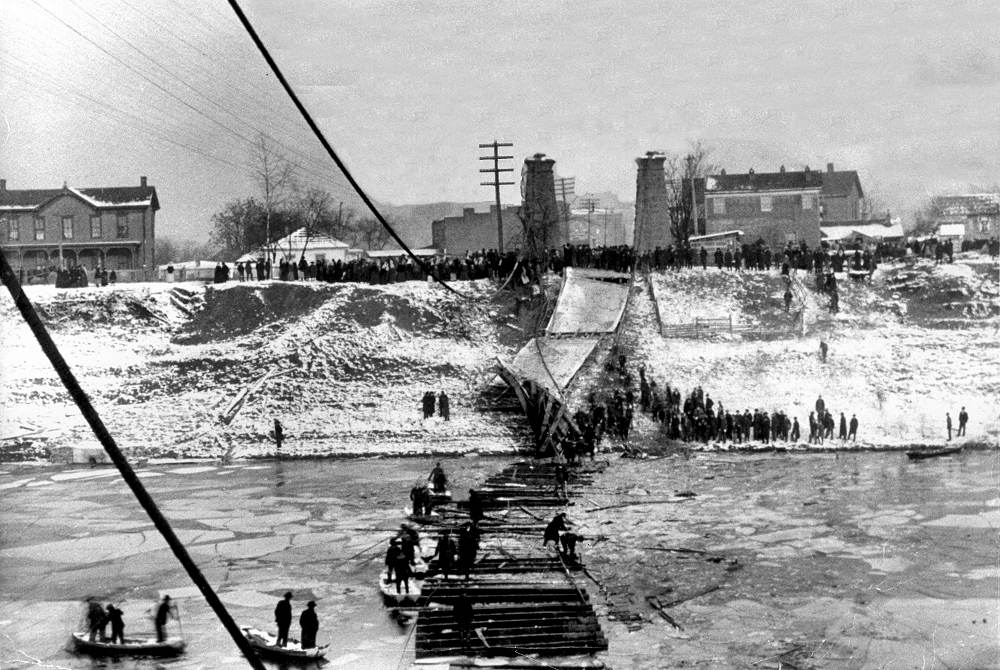
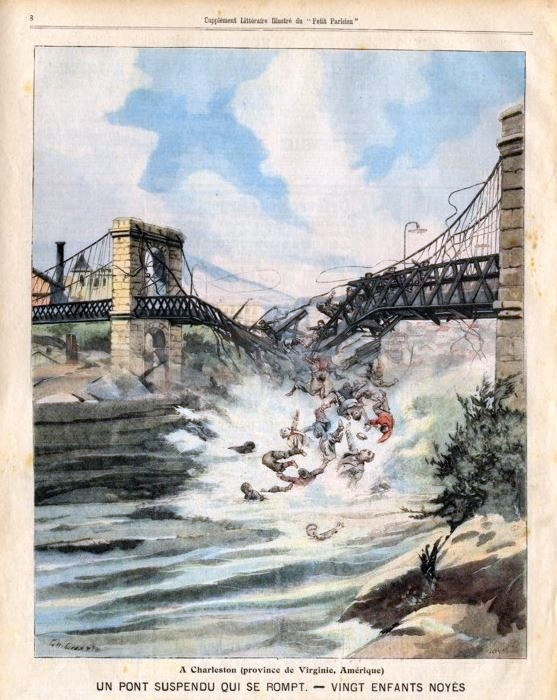
Thronged with boys and
girls on their way to school and with teams and drivers, the Wire
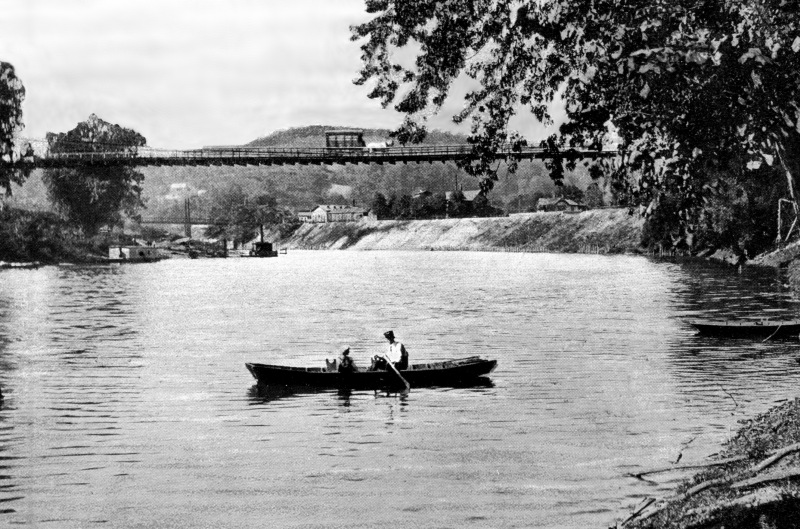
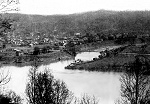
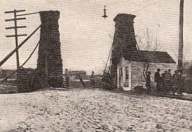
Suspension Bridge across the Elk River at the foot of Lovell street
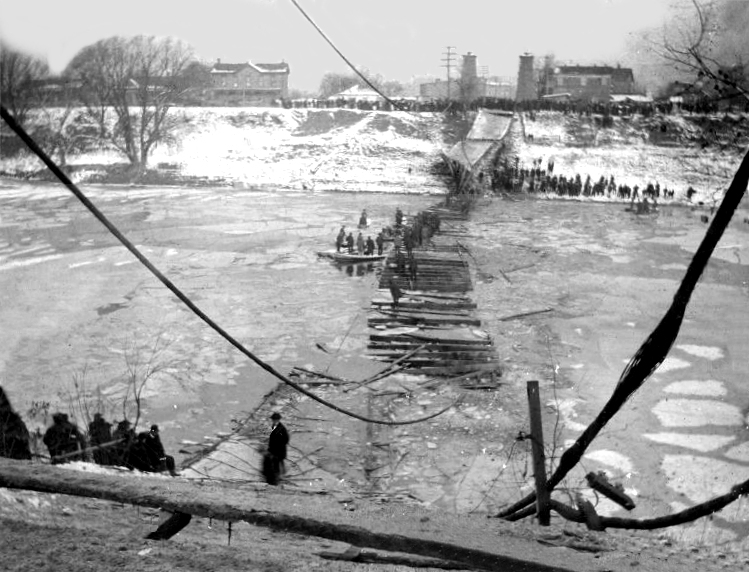
collapsed Thursday morning at 8:15 o'clock with terrible results.
Although, such a catastrophe has been predicted time and time again by
some people no one ever anticipated the occurrence at such time when
the victims are mainly of the school age.
The fatalities first
reported were young girls. Mamie Higgenbotham aged 11, daughter of Ed
Higgenbotham, and Ray Humphreys, aged 15, who resided on the West Side.
Ed Higgenbotham, father of first girl resides on Roane street on the
West Side and is janitor at the Lincoln School building on the West
Side.
The injured include
Zella Smith aged 17, daughter of Wilson Smith, of Pennsylvania avenue.
Compound fracture of the elbow.
William Holmes,
colored driver for Gates and Hogeman, who resides on Truslow street. He
sustained a number of cuts and bruises and suffered from the shock.
Henry Fielder, driver
for Gates and Hogeman, resides on the West Side, sustained serious
internal injuries.
Among those who
escaped uninjured were Lillian Cavender, aged fifteen, who was about
the middle of the bridge and who broke the effect of her fall by
catching a wire as she fell. She was rescued from the debris among the
first. George Woodall, driver fro Gates and Hogeman, also escaped
unhurt. Gordon Young, driver for West Charleston Feed Company, also
escaped.
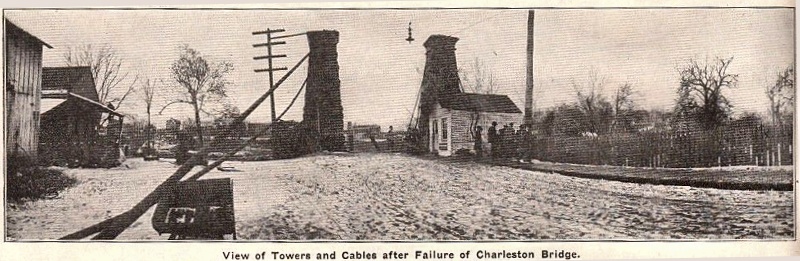
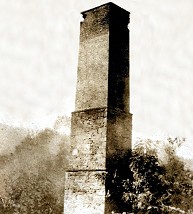
The two large cables
on the upper side of the bridge pulled from their moorings in the stone
anchor on Lovelll street. The accident was due to this. The flooring
was tilted and the people and wagons were slid off. The strain later
snapped one of the cables on the lower side. The flooring dropped and
turned completely over.
Although only two have
been recovered dead so far it is feared that there are several bodies
still under the debris and the ice. A small body was seen on one of the
teams by several people but has not been heard of yet. Ira Woods driver
for the Charleston Milling and Produce Company, is being searched for
by friends who fear that he did not escape.
Immediately on the
arrival of people on the scene of the disaster about twelve skiffs were
manned and people commenced getting out the injured. The fire
department was summoned and under Chief White's direction commenced
doing all they could. Miss Cavender, numb with cold and suffering from
the shock although uninjured was carried from the ice where she dropped
by Chief White. His men and civilians rescued the others.
George Woodall, son of
Judge E. A. Woodall and who is a driver for Gates and Hugeman, was
driving a team about the middle of the bridge when the drop came. He
jumped and landed on the ice and was uninjured.
Gordon Young was
driving a one-horse delivery wagon of the West Charleston Feed Company
on the bridge when the crash came. He jumped onto the ice and crawled
to shore uninjured. His horse was lead out of the water and up the bank
on the West Side and was one of the two horses that were saved out of
thirteen. The animal was barely scratched.
William Holmes, a
colored driver for Gates and Hogeman was carried out among the first.
He was cut about the head and was thought to be badly injured. He was
taken to the Elk Bridge saloon and Dr. W. W. Tompkins called in. His
injuries were found not to be so serious as first supposed and he was
bundled in blankets and taken in the police patrol wagon to his home on
Truslow street.
Henry Fielder, another
driver for Gates and Hogeman who is thought to be seriously injured,
was taken to his home on the West Side in the patrol wagon.
Tom Mickey, colored
driver from R. A. Marshall, was driving a covered delivery wagon across
the bridge when it dropped. His escape with little or no injury is
regarded as miraculous. He was taken to his home on Piedmont road.
The body of little
Mamie Higgenbotham was the first of the dead to be recovered. One of
the skiffs was breaking up the ice near the middle of the river when
the body was seen near the surface. She was taken out streaming with
water and with an ugly cut on the forehead. The little body was carried
to the store of A. P. Silverstein near the bridge where she remained
until she was taken to the undertaking establishment of the Mead
Brothers and Company
Nearly an hour lapsed
before the body of Ray Humphreys was found. It was taken charge of by
J. W. Hill of Mead Brothers and Company and was removed to that
establishment where the inquests will be held.
By this time several
thousand people gathered on the banks of the river and it was all the
police could do to force the crowds to observe the police line.
Mayor Rudesill arrived
on the scene early and under his supervision the police and fire
department conducted the work of rescuing the bodies. The patrol wagon
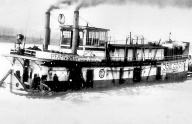
was kept on the scene all the time. The steamer Baxter was secured to
come up the river and break the ice and that work is now going on.
United States Engineer
Thomas E. Jeffries has sent for a diver from one of the government
locks and the man and the heavy apparatus used in his work are expected
Thursday evening.
Miss Lillian Cavender
of Ohio avenue who was about the middle of bridge when the crash came
and who was uninjured in spite of the terrible fall she had, was
removed as soon as she was rescued from the ice and debris to the
residence of James Bibby on Lovell street. Wrapped in blankets and
heavy comforts she coolly talked to a Mail reporter barely an hour
after her terrible experience.
"A party of girls
composed of Mamie Higgenbotham, Zella Smith, Louise McWhorter, Ray
Humphreys, my sister Louise and myself were all walking across the
bridge on our way to the Union School building. Ray Humphreys and Mamie
Higganbotham were a short distance behind Zella Smith and me and my
sister and Louise McWhorter were just ahead. It was exactly 8:15
o'clock.
"I didn't hear any
crash and the first thing I knew was that I was falling. As I fell, I
clutched a wire and stopped myself for a moment, but it cut my hand so
I had to let go. I think that wire kept me from being hurt. On the
bridge at the time, I remember six wagons. There was a little boy on
the seat of one of them. I don't know who was behind us. My sister and
Louise McWhorter felt the flooring sinking and they ran and got off"
Although some of the
people on the bridge declare there was no crash, residents in that
vicinity declare the noise could be heard all over that part of the
town.
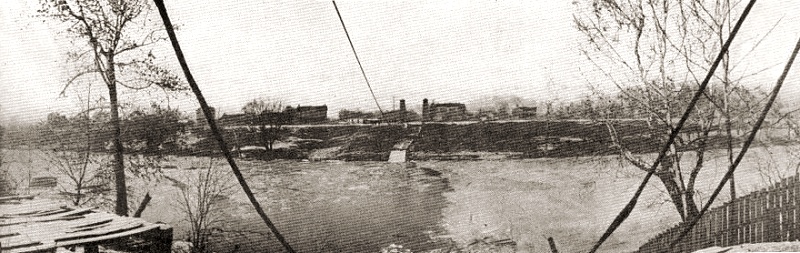
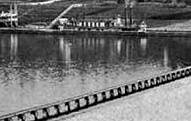
The wire suspension
bridge across Elk was built in 1852, and at that time was considered
quite a wonderful structure. It's cables were severed during the civil
war and then a pontoon bridge was erected and used for a time. After
the war the old cables were spliced and new ones added to make it a
safer structure.
Of late years the
bridge had been very wobbly and some two years ago it shook so when a
team or two was crossing it that passengers on the bridge at the same
time had to walk like sailors to keep their balance, and it became
popularly known as the "drunken bridge." At the same time it was badly
sagged and one corner dropped down and the West Side end toward Kanawha
became badly sagged. A new floor was then laid and this seemed op give
the structure more stability at least temporarily.
Of late years, owning
to the growth of Charleston, and its industrial and commercial
development, the traffic over this bridge became very heavy; in fact,
by many, it was considered too heavy for a structure of that character,
as the span was a very long one, between 600 and 800 feet.
Last September, on
Labor Day, when the parade of the labor organizations of Charleston was
arranged for it was originally on the program to start from the West
Side, but the program was later changed so that the parade started from
the east side of Elk, abandoning the West Side, and thus dispensing
with the crossing of the bridge on account of the statement as
published in the Charleston papers at the time, of the "unsafe"
condition of that bridge.
Two schoolgirls who
had just stepped on the west end of the bridge when it collapsed and
who sustained falls of but ten or twenty feet were worse injured than
those who dropped to the water. Ottie Gibbs, fifteen-year old daughter
of A. A. Gibbs of Cinder Road, had both hips broken and an arm broken.
Her injuries are thought to be fatal. She was moved to the residence of
Mrs. Hubbard on Charleston street near the bridge. Elma Tucker aged 13
years, daughter of J. F. Tucker of Glenwood Heights who was in company
with the Gibbs girl, sustained fractures of both arms and a broken leg.
She had regained consciousness at noon and hopes for her recovery are
entertained.
Among the wild rumors
circulated were those that Dr. C. E. McMillian, John C. Thomas and a
girl named Beckwith were missing. These reports have proved untrue when
investigated by the Mail and all the persons are safe and sound.
About one o'clock,
Miss Zella Smith, who sustained a compound fracture of the arm and who
was taken to the nearby residence of C. G. Gebhart, was operated upon
by physicians and is resting easily.
|